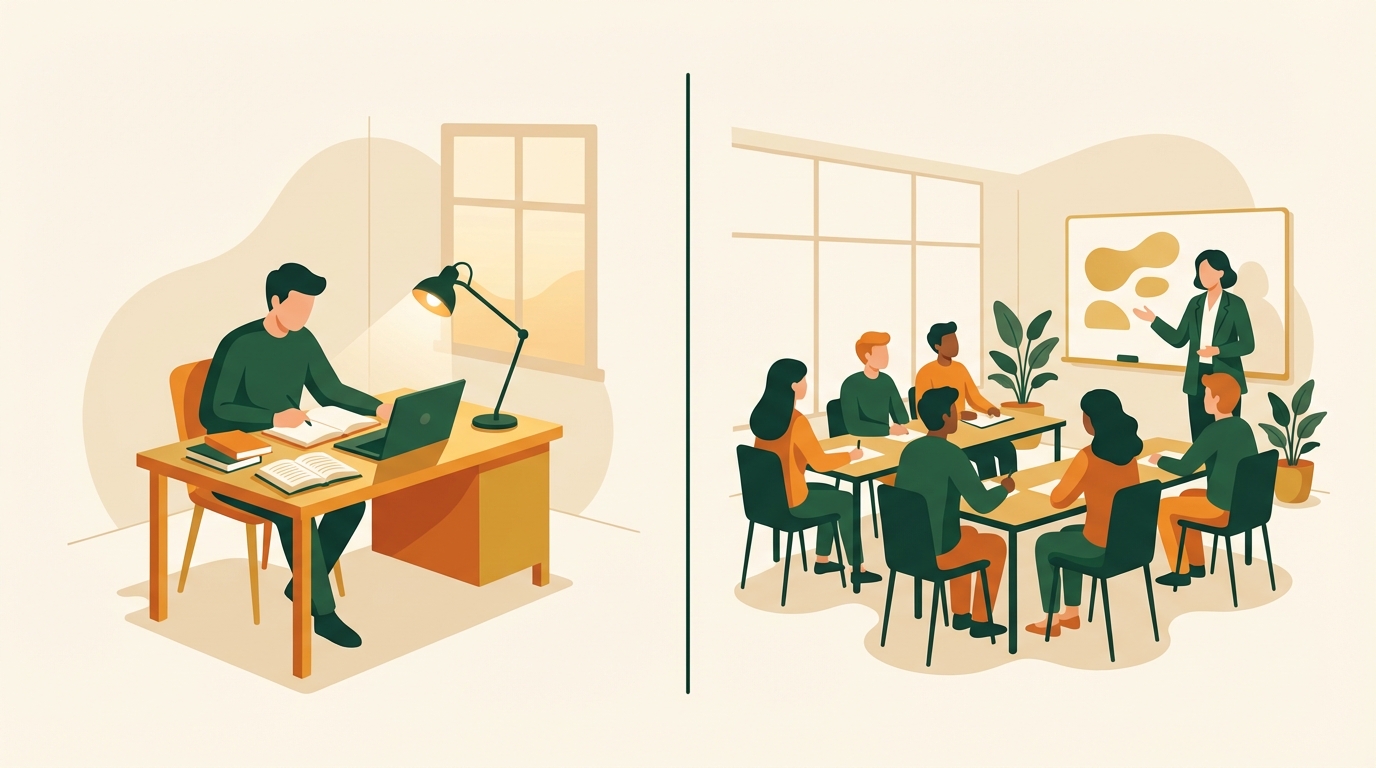
Quick Answer: Review centers offer structure, expert guidance, exam simulation, and peer support that statistically improve your chances of passing. Self-review costs almost nothing and offers maximum flexibility but requires exceptional discipline. Both approaches produce passers and topnotchers. The best choice depends on your self-discipline, academic background, available resources, and budget.
Introduction
The decision between self-review and enrolling in a review center is one of the most debated topics among board exam takers in the Philippines. Scroll through any Facebook group for CPALE, NLE, or LET reviewees and you will find passionate arguments on both sides — those who swear by their review center experience and those who proudly passed through self-study alone.
The truth, as usual, lies somewhere in between. Neither approach is universally superior. What works depends entirely on the individual — your learning style, discipline, academic background, financial situation, and the specific exam you are preparing for. This guide provides an honest comparison to help you decide.
Understanding the Two Approaches
What Is Self-Review?
Self-review means preparing for your board exam independently, without enrolling in a formal review center. This involves:
- Creating your own study schedule and curriculum
- Sourcing your own review materials (textbooks, online resources, borrowed handouts)
- Administering your own practice exams
- Managing your own motivation and accountability
- Studying alone or with informal study groups
What Is Review Center Enrollment?
Enrolling in a review center means paying tuition to attend a structured program that provides:
- A predetermined curriculum and schedule
- Expert instructors for each subject area
- Official review materials and handouts
- Regular quizzes, mock exams, and feedback
- A physical or virtual classroom environment
- A community of fellow reviewees
Cost Comparison
Let us start with the most tangible difference — money.
Self-Review Costs
| Expense | Estimated Cost (PHP) |
|---|---|
| Textbooks and materials | 500–3,000 |
| Printed handouts | 200–500 |
| Internet for online resources | 1,500–2,500/month |
| Practice exam books | 300–800 |
| Total (3-month period) | 5,500–11,300 |
Review Center Costs
| Expense | Estimated Cost (PHP) |
|---|---|
| Tuition fee | 5,000–21,000+ |
| Relocation (if needed) | 12,000–24,000 |
| Food and transport | 12,000–30,000 |
| Miscellaneous | 3,000–6,000 |
| Total (3-month period) | 32,000–81,000+ |
The Verdict on Cost
Self-review is dramatically cheaper — potentially saving you PHP 20,000–70,000. However, this calculation changes if you consider the cost of failing and retaking the exam, which adds months of delayed earnings, another exam fee, and potentially the review center tuition you were trying to avoid.
Effectiveness: What the Data Suggests
The Challenge of Comparing
Here is an important fact: the PRC does not track board exam results by review center attendance. Results are tracked by school of graduation. This means there is no official data directly comparing passing rates of review center enrollees versus self-reviewers.
What We Can Infer
Despite the lack of direct data, several observations are informative:
-
The vast majority of board topnotchers attended review centers. Across the CPALE, NLE, LET, and other exams, topnotchers almost universally credit their review center preparation.
-
National passing rates are low for many exams. The CPALE hovers at 30–34%, and certain NLE administrations fall below 50%. These rates include both review center enrollees and self-reviewers. Given that the majority of examinees attend review centers, it is reasonable to assume that self-reviewers would have even lower aggregate passing rates.
-
Self-reviewers who pass tend to have specific advantages. They typically graduated from strong academic programs, had high GPAs, and possess above-average self-discipline.
-
Both approaches produce passers. Some self-reviewers pass on their first attempt, and some review center enrollees fail multiple times. The approach matters less than the quality and consistency of your preparation.
Detailed Pros and Cons
Self-Review Pros
- Minimal cost. The biggest advantage — you save thousands of pesos.
- Complete flexibility. Study what you want, when you want, at your own pace.
- Customized focus. Spend more time on your weak subjects and less on areas you already know well.
- No commute. Study at home or wherever is most comfortable.
- Independent learning skills. Developing the ability to teach yourself is a valuable professional skill.
Self-Review Cons
- No structured curriculum. You must figure out what to study, in what order, and how deeply — which takes significant planning.
- No expert guidance. When you encounter a concept you do not understand, you have no instructor to explain it.
- No exam simulation. Creating your own timed mock exams is difficult and less authentic than review center simulations.
- No accountability. Without external structure, procrastination is a constant threat.
- Isolation. Studying alone for months can be mentally draining and emotionally difficult.
- Outdated materials risk. Without expert curation, you might study from outdated textbooks or handouts that no longer match the current exam format.
- Exam anxiety. Without the confidence-building experience of review center mock exams and instructor validation, exam anxiety can be higher.
Review Center Pros
- Structured, expert-designed curriculum. Everything is planned for you — subjects, sequence, depth of coverage.
- Qualified instructors. Teachers who specialize in board exam preparation and understand exam patterns.
- Updated materials. Handouts and problem sets that reflect the latest exam format and content.
- Regular mock exams. Timed, realistic practice exams that build confidence and identify weaknesses.
- Peer community. The motivation and support of studying alongside fellow reviewees.
- Accountability. A fixed schedule and attendance expectations keep you on track.
- Track record. Established centers like TopRank (NLE), CPAR (CPALE), and CBRC (LET) have documented histories of producing passers and topnotchers.
Review Center Cons
- Significant cost. Tuition alone ranges from PHP 5,000 to PHP 21,000+, and living expenses can triple that.
- Fixed pace. The class moves at a set speed — too fast if you need more time on a topic, too slow if you already understand it.
- One-size-fits-all approach. The curriculum is designed for the average student, not your specific strengths and weaknesses.
- Geographic constraints. Most centers are in major cities, requiring relocation for provincial students.
- Passive learning risk. Some students attend every session but do not actively engage, resulting in poor retention despite high attendance.
- Schedule rigidity. Full-day classes may conflict with work or family obligations.
The Hybrid Approach: A Third Option
Many successful board exam passers use a combination of both approaches:
Hybrid Strategy 1: Self-Review + Purchased Materials
- Study independently but purchase official review center handouts and materials
- Cost: PHP 2,000–5,000 for materials
- Best for: Strong self-studiers who want expert-curated content
Hybrid Strategy 2: Online Review + Self-Study
- Enroll in an affordable online review center (like IPASS at PHP 5,000) while supplementing with independent study
- Cost: PHP 5,000–10,000
- Best for: Budget-conscious students who want some structure
Hybrid Strategy 3: Classroom Review + Extra Self-Study
- Enroll in a full review program and supplement with additional self-study hours
- Cost: PHP 5,000–21,000+ (tuition) plus living expenses
- Best for: Those who want maximum preparation and can afford it
Decision Framework
Answer these questions honestly to guide your choice:
Choose Self-Review if:
- You graduated with honors or high academic standing
- You have excellent self-discipline and can maintain a study schedule without external pressure
- You cannot afford review center tuition and living expenses
- You have access to updated, quality review materials
- You are a retaker who already understands the exam format
- You learn best independently
Choose a Review Center if:
- You are a first-time taker and unfamiliar with the exam format
- You struggle with self-discipline or procrastination
- You are preparing for an exam with a low passing rate (CPALE at 30–34%)
- You have been out of school for more than a year
- You learn best in a structured, social environment
- You can afford the investment
- Your university's board exam passing rate is below average
What Successful Self-Reviewers Do Differently
If you choose self-review, learn from those who succeeded:
- They create a detailed study plan before Day 1, including daily schedules, weekly targets, and monthly milestones.
- They source quality materials — borrowing from friends who attended review centers or purchasing official handouts.
- They take timed practice exams every week, simulating real exam conditions.
- They join study groups — even informal ones on Facebook or Telegram — for accountability.
- They study full-time during the review period, treating it like a job.
- They are honest about their weak areas and allocate extra time accordingly.
- They set boundaries — no social media, no late nights, no skipping study days.
What Successful Review Center Students Do Differently
Enrollment alone does not guarantee results. Successful review center students:
- Attend every single session without exception.
- Sit at the front and actively engage with the instructor.
- Review notes the same day rather than letting them pile up.
- Complete all assigned practice problems even when they are difficult or time-consuming.
- Supplement with self-study — 2–4 additional hours of independent review daily.
- Take mock exams seriously and analyze their mistakes.
- Form study groups with committed classmates.
Frequently Asked Questions
Do employers know whether I used a review center?
No. Your PRC license does not indicate how you prepared. Employers see only that you are a licensed professional.
Can I buy review center materials without enrolling?
Some centers sell materials separately (CBRC has an online shop, for example). You can also find secondhand materials from previous enrollees.
Is self-review harder for first-time takers?
Generally yes, because first-time takers are unfamiliar with the exam format, time pressure, and types of questions. A review center helps bridge that gap.
What if I try self-review and it is not working?
You can switch to a review center if there is still time before the exam. Some centers accept enrollees even a few months before the exam date.
Are there free review center options?
CBRC periodically offers free LET review. Some universities offer free review programs for their graduates. Free online resources like ReviewersPH provide practice materials.
How do I know if I am ready for the exam?
Consistently scoring 80%+ on timed mock exams across all subjects is a good indicator of readiness, regardless of whether you self-reviewed or attended a center.
Can I combine materials from different review centers?
Yes, some students do this. However, be careful about information overload and contradictory teaching approaches. It is usually better to use one primary source and supplement sparingly.
Is it true that some self-reviewers become topnotchers?
Yes, though it is rare. Most topnotchers credit their review center preparation, but a few exceptional individuals have placed in the top ranks through self-study.
Final Thoughts
The self-review vs. review center debate will never have a definitive winner because the "best" approach is the one that matches your individual circumstances. A review center cannot compensate for a lack of effort, and self-review cannot replace the structured, expert guidance that many students need.
Be honest with yourself about your strengths, weaknesses, discipline, and financial situation. Then commit fully to whichever path you choose. Half-hearted preparation — whether in a review center or at home — is the only truly bad option.
Whichever route you take, SchoolFinderPH can help you explore your options. Browse review centers by exam type, location, and format in Manila, Cebu, Davao, and across the Philippines.